Tyres shape how fast, how comfortable and how safe your riding is more than you might think, and replacing them is a relatively small investment with a big effect. In our workshop we fit tyres for road, gravel and mountain biking every day. Below are the tyres we recommend most often ourselves, by type.
Rolling resistance, puncture protection and wet grip come from the lab tests at BicycleRollingResistance.com. Rolling resistance in watts: lower is faster. Puncture protection and wet grip in points: higher is better. Only compare tyres of the same size and pressure.
Best road tyres
Road tyres are about low rolling resistance, grip in wet corners and enough puncture protection for everyday roads.
The benchmark road tyre: low rolling resistance (10.2 watts in 28 mm), light and available in every common size. It was Continental's first road tyre approved for hookless rims (up to 5 bar). Tubeless fitting is easier than on the old GP5000 TL.
Who it suits: Riders who want one fast, dependable tyre for training and racing alike.
Almost as fast as the GP5000 S TR, but with roughly 25% more puncture protection and 15-20% more grip on wet roads according to BRR. For Dutch conditions a very strong all-rounder. On hookless rims it is 28 mm and wider only.
Who it suits: Riders who want speed but regularly meet wet roads and rough surfaces.
The all-season version of the GP5000: an extra layer in the casing, a thicker tread and, according to BRR, the best wet grip of any road tyre under 30 mm they have tested. It still rolls briskly, but it is around 80 grams heavier than the S TR.
Who it suits: Riders who keep going all year, autumn and winter included.
A light tubeless tyre with the highest tread puncture protection in this list (73 points at BRR, double that of the GP5000 S TR) and excellent wet grip. It does roll noticeably slower. Hookless compatible.
Who it suits: Riders whose priority is simply not puncturing, in training or on rough roads.
A tubeless tyre with a 320 TPI cotton casing: supple and comfortable, with the ride feel its fans swear by. Wet grip and tread puncture protection are both good. It is the most expensive tyre here, and it comes with tan sidewalls.
Who it suits: Riders who love a supple ride on good roads.
The fastest gravel tyre in this selection: 15.7 watts in 40 mm according to BRR. It has a fine tread for hardpack gravel and trails, and the new Addix Race compound gives good wet grip through the centre.
Who it suits: Gravel riders who mainly ride hardpack and surfaced trails.
Fast, decently puncture resistant (42 points) and a good deal cheaper than the competition (around €53). Hookless compatible. Wet grip is only average, so take a little more care on wet roots and brick paving.
Who it suits: Riders after a fast, solid gravel tyre at a fair price.
Schwalbe's all-round tread: more purchase than the RS Pro on loose gravel, yet surprisingly fast. BRR measures it around 30% quicker than the old G-One R. Hookless compatible.
Who it suits: Riders on mixed surfaces, from cycle path to loose gravel.
The grippier sibling of the Terra Speed, with a softer Black Chili compound and slightly taller knobs. That buys more wet grip (67 against 58 points), but also a good deal more rolling resistance.
Who it suits: Riders tackling muddy trails through autumn and winter.
A smooth centre strip for speed on tarmac and hardpack, with side knobs for cornering on gravel. The tread has the highest puncture protection of the gravel tyres here (48 points). Often fitted as standard on Specialized gravel bikes.
Who it suits: Riders mixing plenty of tarmac and cycle path with the occasional gravel section.
The front tyre in Schwalbe's XC race pairing, and according to BRR the fastest-rolling MTB tyre in this selection: 19.3 watts in 2.35 inch. Super Race casing with Addix SpeedGrip compound for cornering grip.
The XC rear tyre of choice for years: low knobs that roll briskly while still giving enough braking grip. In 2.25 inch it is light and fast; in 2.35 inch a little more comfortable.
Who it suits: XC and marathon riders, and anyone wanting a fast all-round rear tyre.
An all-round XC tyre with a graphene-silica compound: fast enough for racing, with more puncture protection (38 points) and wet grip (68) than the Schwalbes. The 2.4-inch version adds comfort and grip.
Who it suits: Riders who want one tyre for racing and trail riding alike.
With the new MaxxSpeed compound it has, according to BRR, the best wet grip of every MTB tyre they have tested. EXO sidewalls protect against cuts. The trade-off: rolling resistance is clearly higher than the Schwalbes and the Vittoria.
Who it suits: Riders in wet conditions who put grip ahead of speed.
Fast, grippy or puncture resistant: pick your priority
Every tyre is a compromise between rolling resistance, grip and puncture protection. In our road list you can see that in the figures from BicycleRollingResistance.com. The Continental Grand Prix 5000 S TR rolls the lightest (10.2 W), the Pirelli P Zero Race TLR RS is barely slower but grips noticeably better in the rain (80 points for wet grip), and the Specialized S-Works Turbo TLR has by far the best puncture protection (73 points) at the cost of a little more rolling resistance.
If you ride through autumn and winter on wet, dirty roads, the Continental Grand Prix 5000 AS TR is the sensible pick: slightly slower, but with the best wet grip in the list and more protection.
What the lab figures do and do not tell you
Rolling resistance is measured on a drum, at a fixed speed, load and tyre pressure. That makes tyres genuinely comparable, but only at the same size and pressure. A difference of 1 to 2 watts per tyre is not something you notice on a short ride, but over a long day or in a time trial it adds up.
Puncture protection and wet grip are scores on their own scale: higher is better. They say something about protection against a sharp object and about grip on a wet test surface, not about how long the tyre lasts. Wear varies a great deal by rider and surface.
Wider is often faster, and more comfortable
Where 23 mm was once standard, 28 mm is now the norm and more and more riders choose 30 or 32 mm. You can run a wider tyre at lower pressure without it becoming slower, and on road surfaces with seams and brick paving it often rolls faster. The conditions are that your frame has the clearance and that the tyre suits the internal width of your rim.
Gravel and MTB: match the tread to your surface
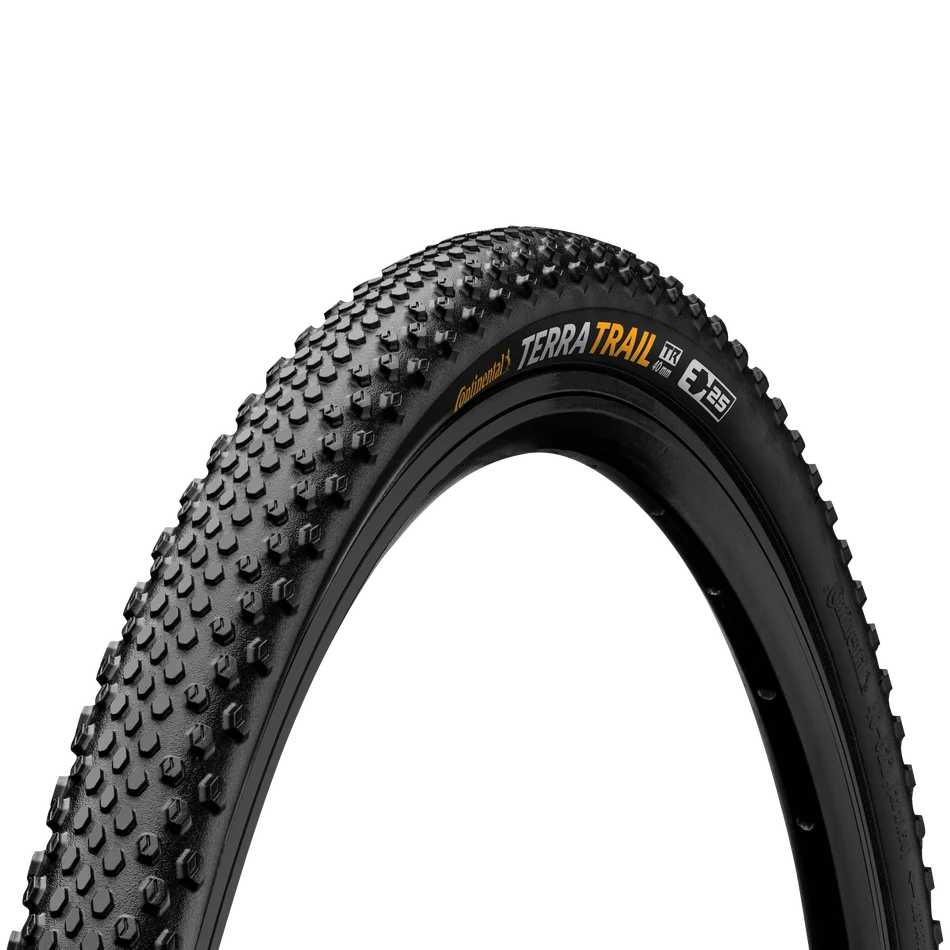
On gravel the surface matters more than the brand. For flat, hardpack gravel and plenty of tarmac, a fast, fine-treaded tyre such as the Schwalbe G-One RS Pro is ideal. If you ride woodland, sand or mud, a tyre with more tread such as the Continental Terra Trail inspires more confidence, at the cost of clearly higher rolling resistance.
Road tyres have grown wider in recent years: 28 to 32 mm is now normal and often rides both faster and more comfortably than narrow. Always check how much clearance your frame has and what the internal width of your rim is.
Tubeless or inner tube
Tubeless runs sealant instead of an inner tube. Small punctures seal themselves and you can run lower pressures. An inner tube is simpler to fit and easy to replace at the roadside.
Rolling resistance, grip and puncture protection
Every tyre is a compromise. A fast race tyre rolls lightly but is more vulnerable; a training or all-season tyre is heavier but lasts longer and punctures less. Choose on the basis of how and where you ride.
Tread and compound
For gravel and MTB the tread pattern decides your grip on loose surfaces. A softer rubber compound grips better but wears faster.
Hookless rims
If you have hookless rims, only fit tyres approved for them and stick to the maximum pressure of both tyre and rim.
Tyre pressure
The right pressure depends on your weight, the tyre width and the surface. Wider tyres run lower pressures. Many manufacturers have a calculator; in the shop we are happy to think it through with you.
Tubeless is less prone to punctures and lets you run lower pressures, which buys comfort and grip. An inner tube is simpler and quicker to swap at the roadside. If you ride a lot on rough roads or gravel, tubeless is usually the better choice.
Which tyre width fits my bike?
That is set by your frame (the clearance between tyre and frame or fork) and the internal width of your rim. Leave a few millimetres spare for dirt. Your bike manufacturer usually quotes a maximum tyre width.
When should I replace my tyres?
There is no fixed mileage. Replace a tyre when the tread is worn flat or square, when the wear indicators have gone, or when cuts and splits expose the casing. Rear tyres usually wear faster than front ones.
How often should I top up tubeless sealant?
Sealant dries out over time. Check it a few times a year and top up as needed; in warm weather it dries faster.
Which road tyre punctures least?
In our selection the Specialized S-Works Turbo TLR has the best puncture protection in the lab test (73 points), well ahead of the rest. The Continental GP5000 AS TR and the Vittoria Corsa Pro follow some way behind. To cut the risk further still, run tubeless.
What is the fastest road tyre?
In our selection the Continental Grand Prix 5000 S TR has the lowest rolling resistance (10.2 W in 28 mm at 5 bar), closely followed by the Pirelli P Zero Race TLR RS (10.5 W). You will barely notice the difference between those two in practice; the Pirelli grips better in the rain.
What tyre pressure should I run with 28 mm tyres?
That depends on your weight, the rim width and the surface. For a rider of around 75 kilos on 28 mm tubeless tyres, manufacturers' calculators usually land around 4.5 to 5.5 bar. On hookless rims never go above 5 bar. Use your tyre or rim manufacturer's calculator as a starting point.
Some links on this page are partner links. If you buy something at a shop through such a link, we earn a commission at no extra cost to you. It does not shape our choices. Quasar is our own brand, and we say so with every Quasar recommendation. Prices are indicative.

 1