Nederlands

The best bike saddles of 2026

No component is this personal. The saddles we recommend most often, and the rider each one works for.

Updated November 2026 · by Alan

What feels perfect to one rider causes complaints for another within an hour. Width, shape and pressure relief make the difference, and so does your position on the bike. That is why we like to pair saddle advice with a bike fit. Below are the saddles we recommend most often, and why.

In short: our picks

Specialized Power Expert Mirror1
Our pick

Specialized Power Expert Mirror

Specialized

Expert review

4.5/5

The 3D-printed Mirror technology from the S-Works flagship, but on titanium rails and for a little over half the price. The short Power shape has a wide central cutout and comes in four widths, from 130 to 168 mm, so it suits almost any sit bone spacing.

Who it suits: Road and gravel riders in an aggressive position who suffer from pressure points.

  • Mirror technology at a sensible price
  • Four widths
  • Standard 7×7 rails: fits any seatpost
  • Heavier than the carbon version
Weight
214 g (143 mm)
Widths
130, 143, 155, 168 mm
Length
240 mm
Rails
Titanium 7×7 mm (hollow)
Shape
Short, Mirror 3D-printed
Pressure relief
Wide cutout
€ 179.99shop price

Available at webshop.cc5311.nl

Full review, specs and comparison

Rider reviews

Specialized S-Works Power Mirror2
Flagship model

Specialized S-Works Power Mirror

Specialized

Expert review

4/5

Specialized's flagship: a carbon shell and rails with the Mirror saddle surface printed from liquid polymers, spreading the load across your sit bones. At 190 grams it is light for a saddle this comfortable.

Who it suits: Riders who want the lightest and most comfortable Power saddle.

  • Light
  • Mirror comfort
  • Carbon shell and rails
  • Expensive
  • Carbon 7×9 rails do not fit every seatpost
Weight
190 g (143 mm)
Widths
143, 155 mm
Length
242 mm
Rails
Carbon 7×9 mm (oval)
Shape
Short, Mirror 3D-printed
Pressure relief
Centre channel
€ 389shop price

Available at webshop.cc5311.nl

Full review, specs and comparison

Rider reviews

Selle Italia SLR Boost 3D Kit Carbonio Superflow3
Lightest option

Selle Italia SLR Boost 3D Kit Carbonio Superflow

Selle Italia

Expert review

4/5

The lightest here at 166 grams, with a 3D-printed surface. It has a large Superflow cutout to relieve pressure on soft tissue. The short Boost shape is built for a low, aerodynamic position.

Who it suits: Racers who ride low and far forward.

  • Very light
  • Large cutout
  • Extra-long rails for fine adjustment
  • Expensive
  • Only two widths
Weight
166 g (S3) / 171 g (L3)
Widths
130 mm (S3), 145 mm (L3)
Length
248 mm
Rails
Carbon 7×9 mm, 10 mm longer
Shape
Short, 3D-printed
Pressure relief
Large Superflow cutout
± € 449indicative

Full review, specs and comparison

Rider reviews

Fizik Vento Argo R1 Adaptive4
Best for gravel and long rides

Fizik Vento Argo R1 Adaptive

Fizik

Expert review

4/5

A short-nosed saddle with a 3D-printed Adaptive surface that spreads pressure. The Argo shape plants you firmly on your sit bones, which pays off on long rides and on gravel.

Who it suits: Gravel and endurance riders who want to sit planted.

  • 3D-printed comfort
  • Stable seating position
  • Light
  • Expensive
  • Two widths
Weight
190 g (140 mm) / 196 g (150 mm)
Widths
140, 150 mm
Length
265 mm
Rails
Carbon oval (7×9 or 7×10 mm)
Shape
Short nose, wide tail, 3D-printed
Pressure relief
3D-printed surface
± € 330indicative

Available at Futurumshop

Full review, specs and comparison

Rider reviews

Prologo Scratch M5 PAS 3D Nack5
Best value carbon

Prologo Scratch M5 PAS 3D Nack

Prologo

Expert review

4/5

A versatile 250 mm saddle with a PAS channel (Perineal Area System) that cuts pressure on soft tissue. The 3D version has a printed surface. On carbon rails it weighs 176 grams.

Who it suits: Riders between a short and a long saddle who want room to shift position.

  • Versatile shape
  • PAS channel
  • Light
  • One width only (140 mm)
Weight
176 g
Widths
140 mm
Length
250 mm
Rails
Carbon (Nack) 7×9 mm
Shape
Medium length, flat
Pressure relief
PAS channel (cutout)
± € 250indicative

Available at Futurumshop

Full review, specs and comparison

Rider reviews

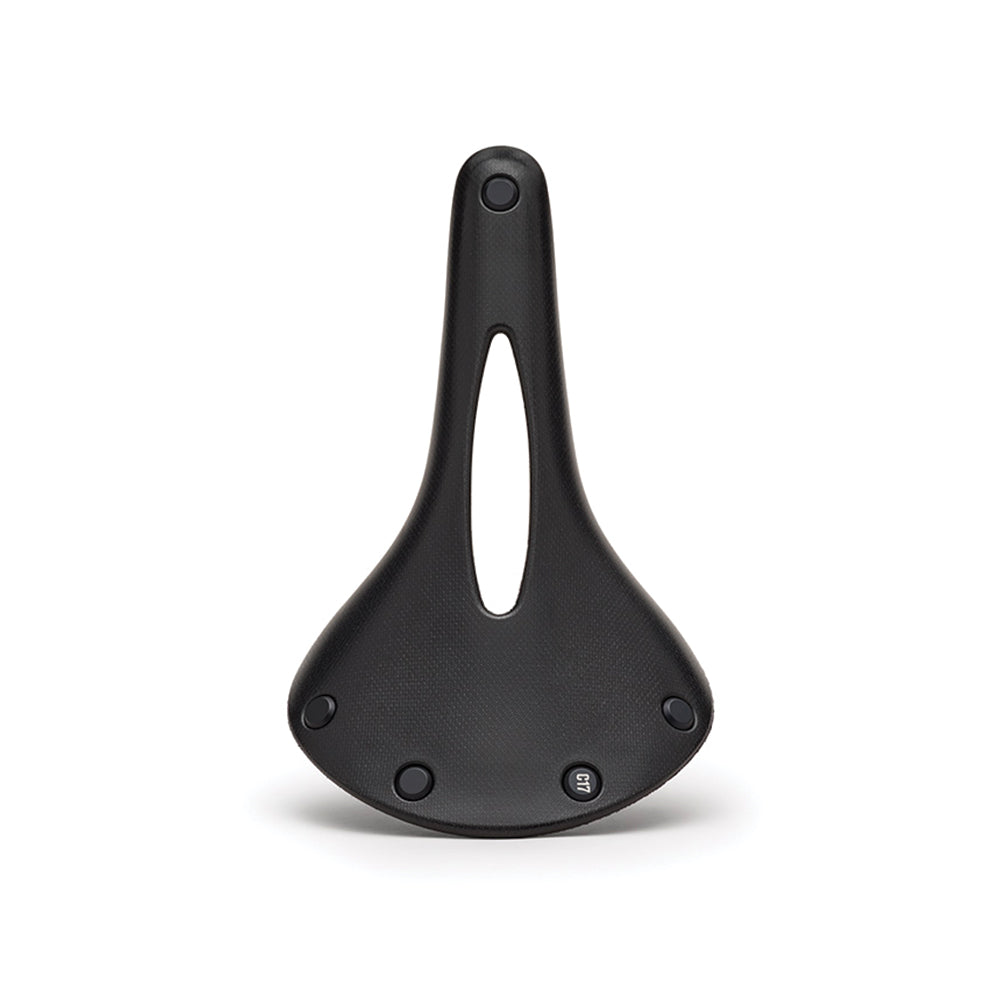
Brooks Cambium C17 Carved6
The comfort choice

Brooks Cambium C17 Carved

Brooks

Expert review

4/5

A classic long, wide saddle made from vulcanised natural rubber and cotton, which flexes like a leather Brooks but needs no breaking in and no maintenance. The Carved version adds a cutout to relieve pressure.

Who it suits: Tourers, bikepackers and anyone sitting upright who puts comfort before weight.

  • No breaking-in period
  • Weatherproof
  • Comfortable in an upright position
  • Heavy
  • Not for an aggressive, forward position
Weight
400-446 g
Widths
162-164 mm
Length
283 mm
Rails
Steel 7×7 mm
Shape
Long, traditional, flexible
Pressure relief
Cutout (carved)
± € 105indicative

Available at bol.com

Full review, specs and comparison

Rider reviews

Buying guide: how to choose the right saddles

Start with your sit bones and your position

The right saddle starts with two things: the distance between your sit bones and how far forward you lean. The sportier your position, the more you rotate forward and the narrower the part of your pelvis you sit on. Riders who sit upright usually need a wider saddle than someone low on a road bike. That is why most brands offer their saddles in several widths, such as the Specialized Power Expert Mirror in 130, 143, 155 and 168 mm.

Short saddle or classic long saddle?

Short saddles with a wide nose, such as the Specialized Power, the Fizik Vento Argo R1 Adaptive and the Selle Italia SLR Boost 3D Kit Carbonio Superflow, have become the standard in recent years. They support you well when you are low and forward, because there is less saddle nose to press on. A longer, flatter saddle such as the Prologo Scratch M5 PAS 3D Nack gives you more room to shift position during the ride.

3D-printed saddles: what is the difference?

In a 3D-printed saddle the padding is not foam but a polymer lattice built differently zone by zone: softer where you want to sink in, firmer where you need support. That spreads pressure more evenly than foam. Many riders with pressure points or numbness benefit. The downsides: they cost more and the open structure needs a little more cleaning after a dirty ride.

Pain is not always the saddle

In the workshop we often find that saddle pain comes partly from the set-up: a saddle that is too high, a nose tilted too far up or down, or bars that are too far away. Before you buy a new saddle, it pays to check your saddle height and tilt first.

What to look for in saddles

Width

Your saddle has to match the spacing of your sit bones. Too narrow and you sit on soft tissue; too wide and it chafes the inside of your legs. That spacing is easy to measure.

Shape

A flat saddle gives you room to shift about; a curved one holds you in one place. Short saddles with a wide nose are popular with riders in a low, aerodynamic position.

Pressure relief

A cutout or channel down the middle takes the load off soft tissue. For many riders that makes a big difference, especially in an aggressive position and on long rides.

Padding and 3D printing

More padding is not automatically more comfortable; a firmer saddle supports you better over a long ride. 3D-printed saddles spread the load differently and suit a lot of riders well.

Rails

Steel and titanium rails fit virtually any seatpost. Carbon rails are lighter but often have an oval profile; check that your seatpost clamp takes them.

Position

Saddle pain often comes not just from the saddle but from saddle height, tilt or your bar position. Getting the fit right sometimes solves more than a more expensive saddle.

Frequently asked questions

Why does my saddle hurt?

Usually a combination of a saddle that does not match your width or position and a set-up that is off. Numbness or tingling is a clear sign of too much pressure on soft tissue. In most cases it is readily fixed.

How do I work out the right saddle width?

By measuring the distance between your sit bones, for instance by sitting on a measuring pad. A bike fit normally includes this.

How long does it take to get used to a new saddle?

Allow a few weeks and several longer rides. A little soreness around the sit bones is normal at first; persistent pain, chafing or numbness is not.

Are 3D-printed saddles worth the money?

For many riders yes, particularly if they suffer from pressure points. It stays personal, so try a demo saddle first if you can.

Which saddle helps against numbness?

A saddle with a cutout or channel down the middle takes the load off soft tissue, and the right width makes sure you sit on your sit bones rather than between them. 3D-printed saddles such as the Specialized Power Mirror also spread pressure more evenly. If the tingling persists, have your fit checked.

Which saddle is good for gravel?

On gravel you usually sit a little more upright and spend longer in the saddle. A saddle with a bit more flex and support at the rear, such as the Fizik Vento Argo R1 Adaptive or the robust Brooks Cambium C17 Carved, often works well.

How do I set my saddle up properly?

Start with height: with your heel on the pedal at the bottom of the stroke, your leg should be almost straight. Then set the saddle level or with the nose a fraction down, and make sure your knee sits roughly above the pedal axle with the cranks horizontal. Adjustments of a few millimetres already make a difference.

Some links on this page are partner links. If you buy something at a shop through such a link, we earn a commission at no extra cost to you. It does not shape our choices. Quasar is our own brand, and we say so with every Quasar recommendation. Prices are indicative.